How Much Does It Cost to Build a Website? What Really Drives the Price
Two quotes for "a website" can differ tenfold. Here is what actually drives the cost of a website — and how to brief a developer so you get an accurate, comparable quote.
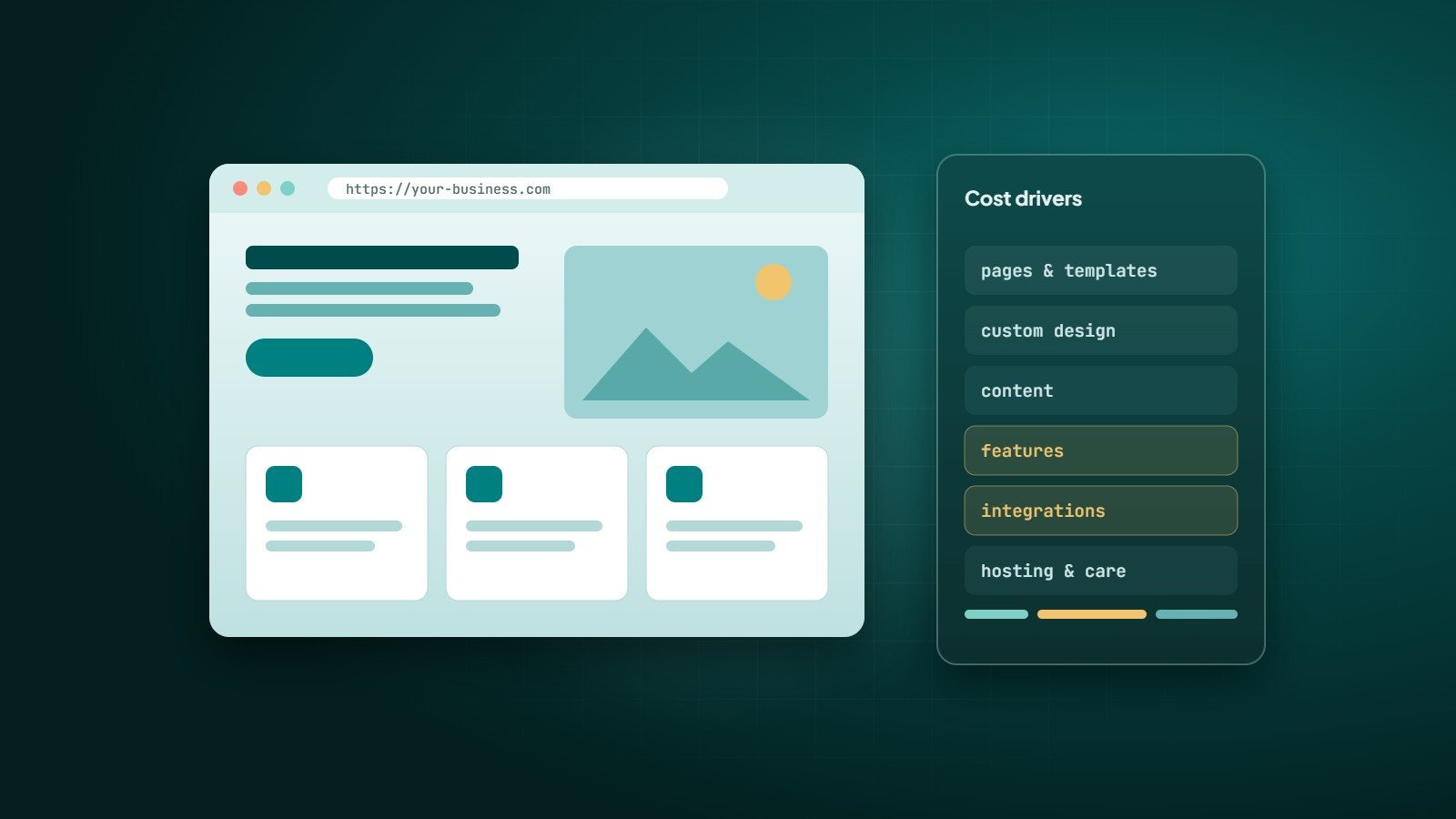
Ask three developers what a website costs and you may get three very different answers. That is not because some of them are guessing — it is because "a website" can mean a single landing page or a multi-language platform with customer accounts, payments and integrations. The price follows the scope.
This guide explains what really drives the cost, so you can understand quotes, compare them fairly and decide where your budget matters most.
The short answer
The cost of a website depends mainly on how much has to be designed and built, how much of it is custom and what it must connect to. A small brochure site built on a solid template is at the low end. A custom-designed site with a content management system, several languages and a booking or payment flow sits much higher. Ongoing costs — hosting, domain, security updates and support — come on top.
The main cost drivers
1. Type of website
| Type | Typical scope | Relative cost |
|---|---|---|
| Landing page | One focused page for a campaign or product, with a contact or sign-up form | Lowest |
| Company / brochure website | Home, services, about, contact and a blog; editable content | Low to medium |
| E-commerce store | Catalogue, cart, checkout, payments, shipping, order management | Medium to high |
| Web application or portal | User accounts, roles, dashboards, custom business logic | Highest |
2. Number and variety of page templates
Cost is driven less by the total number of pages than by the number of different page layouts. Fifty blog posts that share one template are cheaper than ten pages that each need a unique design. When you brief a developer, list the page types you need — for example home, service page, article, contact — rather than only a page count.
3. Design: template or custom
A good template adapted to your brand is faster and cheaper. A custom design — planned around your audience, with original layouts and components — takes longer but makes your business look distinct and can be shaped around how your customers actually decide. Many projects use a middle path: a proven component system with custom design for the pages that matter most.
4. Content
Content is one of the most underestimated parts of any website project. Who writes the text? Who provides photos, translations, product data? If the developer or agency produces or migrates content, that is real work and should appear in the quote. Delayed content is also the most common reason website launches slip.
5. Features and functionality
Each feature adds design, development and testing time. Common examples:
- Contact and quote forms, newsletter sign-up
- Search and filtering
- Booking or appointment scheduling
- User accounts and member areas
- Online payments
- Multiple languages, including right-to-left languages such as Arabic
6. Integrations
Connecting your website to other systems — a CRM, an accounting or inventory system, a payment gateway, a shipping provider, WhatsApp or email marketing — often costs more than the visible pages. The effort depends on how good the other system's API and documentation are.
7. Performance, SEO and security
A site that loads quickly, is correctly structured for search engines and is protected against common attacks does not happen by accident. Technical SEO (titles, structured data, sitemaps, clean URLs), image optimisation, HTTPS, secure forms and backups are part of a professional build. A cheap quote often saves money by skipping exactly these things.
Ongoing costs to plan for
- Domain name — renewed every year.
- Hosting — from shared hosting for small sites to cloud servers for applications with heavy traffic.
- SSL certificate — often included free with modern hosting.
- Maintenance — software updates, security patches, backups and monitoring.
- Improvements — new pages, features and content as your business grows.
A website is not a one-time purchase. Budget for its first year of care, not only its launch.
Why the cheapest quote can cost more
A low price usually means something has been left out: content, responsive testing on real devices, SEO foundations, security, documentation, or the ability for you to edit the site yourself. Those gaps tend to surface after launch, when fixing them is more expensive. When comparing quotes, compare the scope, not just the number.
How to get an accurate quote
The more clearly you describe what you need, the more accurate — and comparable — the quotes will be. Include:
- Your goal — more enquiries, online sales, bookings, credibility for investors?
- Your audience — who they are, which languages they read, which devices they use.
- The page types you expect, and 2–3 websites you like (and why).
- Must-have features versus nice-to-haves.
- Systems to connect — payments, CRM, WhatsApp, email.
- Who provides content — text, images, translations.
- Your timeline and any fixed launch date.
Ways to keep the cost under control
- Start with a focused first version. Launch the pages and features that bring results, then add more based on real usage.
- Prepare content early. It speeds up the project and avoids rework.
- Use proven building blocks for standard features, and invest custom work where it differentiates you.
- Ask for a phased plan with a clear scope and price for each phase.
Key takeaways
- Website cost follows scope: type of site, page templates, design, content, features and integrations.
- Integrations and content are the most underestimated parts of the budget.
- Plan for ongoing costs: domain, hosting, maintenance and improvements.
- A clear brief is the best way to get accurate, comparable quotes.
How Wintecsys can help
We design and build websites — from focused landing pages to company websites, online stores and web applications — with performance, technical SEO and security included from the start. Send us a short description of your project and we will reply with questions, a recommended scope and a clear quote.